Typing Practice for Beginners: A Simple Learning Plan
A beginner does not need to learn the entire keyboard at once. A structured course introduces a small number of keys, combines them with previously learned keys, and gradually builds natural words and sentences.
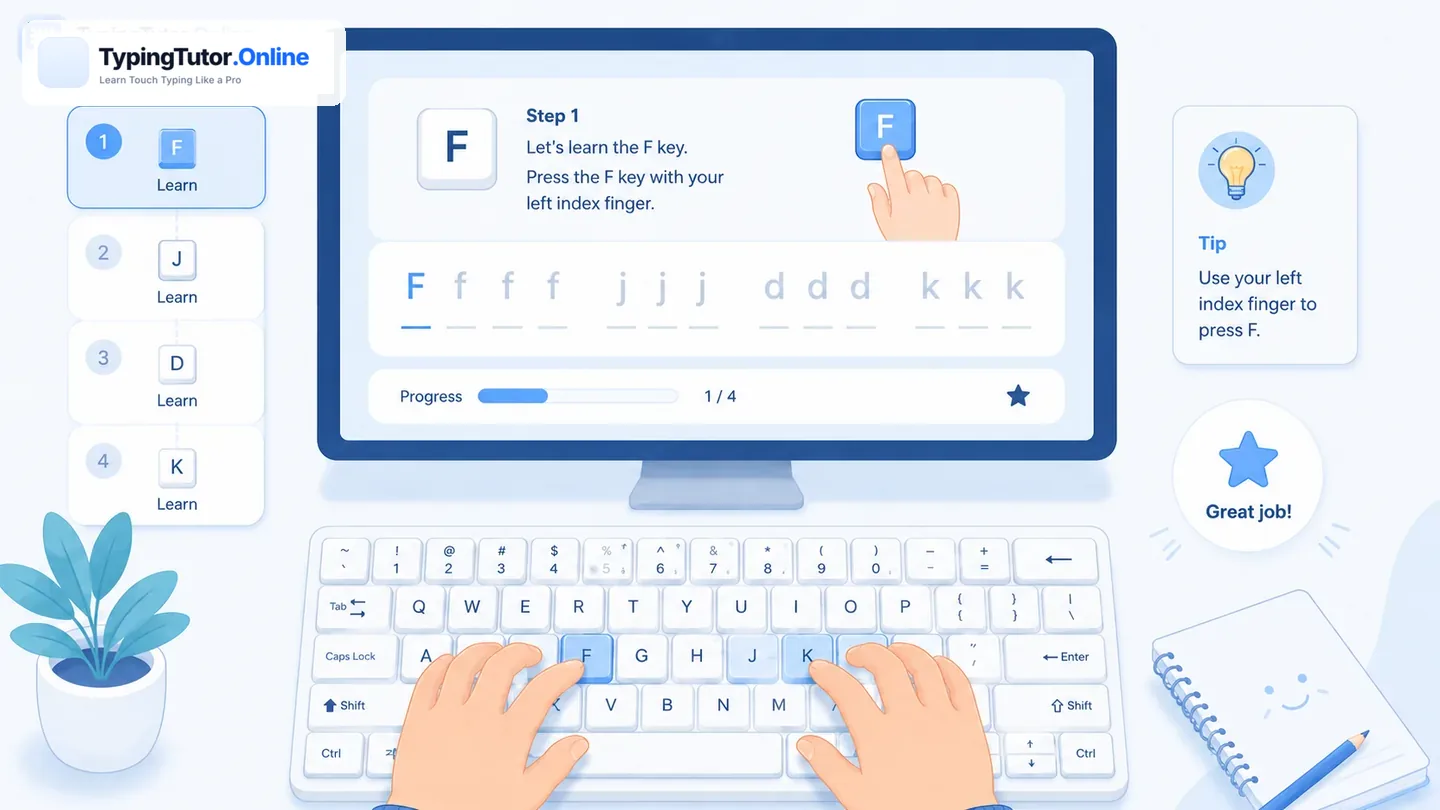
Stage 1: Master the home row
Begin with F and J as anchors, then add nearby home-row keys. Practise combinations that alternate between both hands. Continue until the keys can be found without looking down and accuracy remains stable.
Stage 2: Add top-row keys cumulatively
When E and I are introduced, combine them immediately with the completed home row. New keys should not be practised in an isolated block only. Every later lesson should continue using earlier keys.
Stage 3: Add the bottom row
Apply the same cumulative method to Z through slash. Use cross-hand combinations and words that include all learned rows. This prevents learners from becoming comfortable only within one row.
Stage 4: Capitals, punctuation and numbers
Use the opposite-hand Shift key for capital letters and shifted symbols. Practise punctuation in complete sentences, and practise numbers inside realistic dates, amounts, percentages, and data-entry patterns.
Do not advance only because a timer ended. Repeat a lesson when the new keys still cause frequent hesitation or accuracy remains below the lesson target.
A 15-minute daily plan
- Two-minute warm-up.
- Eight minutes in the current lesson.
- Three-minute weak-key review.
- Two-minute test or careful sentence practice.
Review progress weekly
Check total practice time, average WPM, accuracy, weak keys, common errors, and recent history. Improvement may first appear as fewer errors and better consistency before it appears as higher WPM.
After learning the keyboard, try typing without looking at the keyboard or plain-text typing without highlight. For typing without a timer, strict no-Backspace practice, or custom text, use the Custom Typing Test Studio.
Read our beginner typing guide for laptop and desktop keyboards or follow a 10-day practice plan. If your hands feel painful, take a break rather than working through it.
Beginner typing questions
Should a beginner use a typing test immediately?
A short test can provide a baseline, but most practice should initially focus on correct finger use and lesson progression.
What is a good beginner speed?
There is no single required starting speed. Consistent accuracy and correct technique matter more. The Beginner Typist Certificate begins at 20 WPM with additional quality requirements.