

Free Typing Lessons: A Beginner-to-Advanced Learning Plan
Free typing lessons are most useful when they form a real course. Instead of repeating random letters, each lesson should add a manageable skill and keep earlier keys in active use.
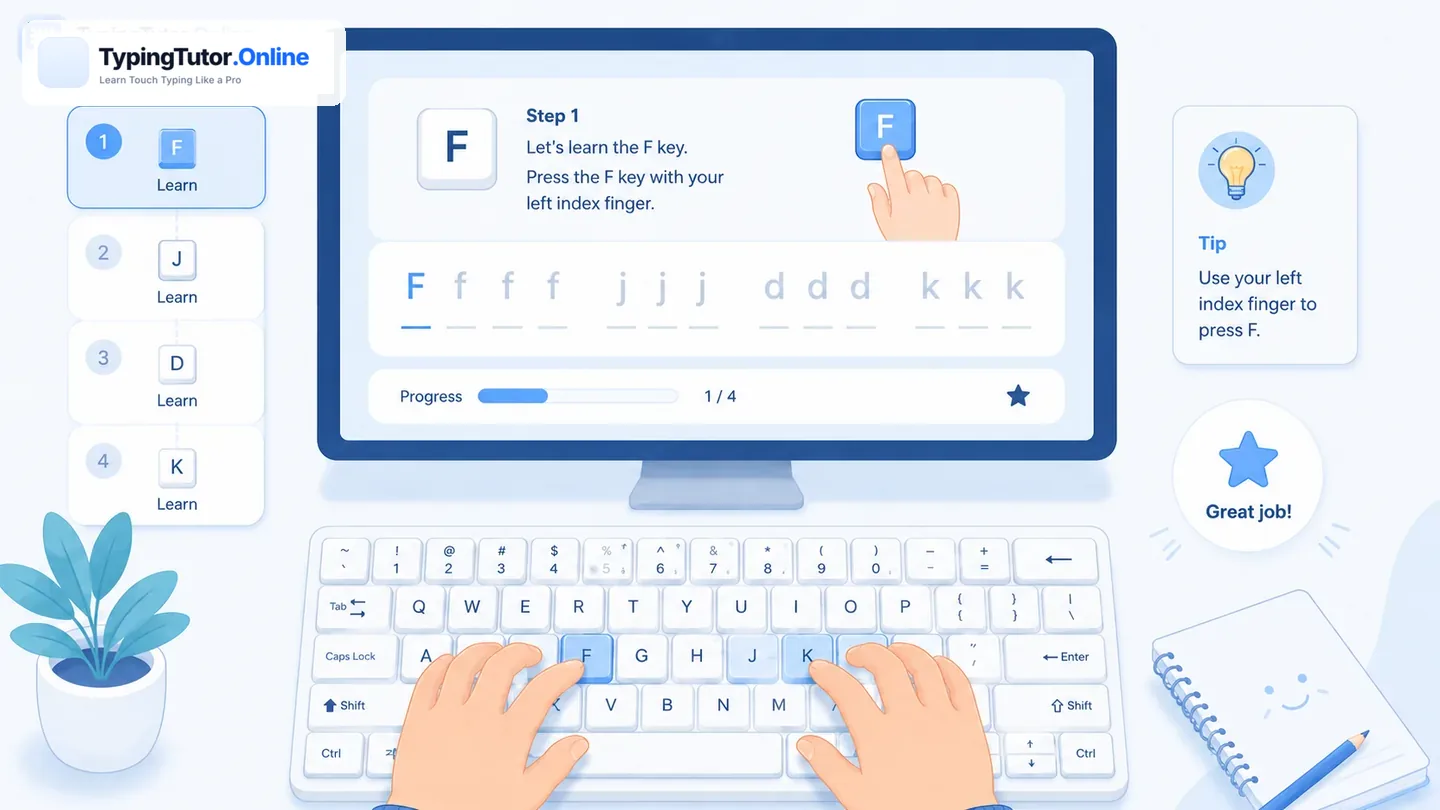
What should free typing lessons teach first?
Start with home-row anchors and finger control. Add keys gradually, then mix new keys with previously learned keys. As soon as the available key set allows meaningful words, practise real language instead of staying on meaningless letter drills for too long.
A complete course should be cumulative
Learning one keyboard row and then forgetting it while moving to another creates artificial separation. A cumulative course keeps earlier keys active while introducing new reaches. This helps the learner build one complete keyboard skill.
From letters to useful text
A full typing course should eventually include capitals, numbers, punctuation, symbols, sentences, office-style writing and longer passages. The final goal is not to pass a letter drill; it is to type real text accurately and comfortably.
Browse all free typing lessons Start your current lesson
Do you have to master every lesson before moving on?
Mastery is useful, but progression should not become a trap. If a learner completes meaningful practice but falls short of the mastery target, it can be reasonable to continue to the next lesson and return later. The course can keep the distinction between completed and mastered.
Use tests to confirm transfer
After several lessons, take a short typing test. Lessons teach the movement; tests reveal whether the skill carries into continuous text without prompts.
How many free typing lessons do you need?
The number matters less than the progression. A good course has enough stages to introduce new keys without overwhelming the learner, then enough cumulative practice to turn those keys into words, sentences and real text. TypingTutor.Online uses a 60-lesson main curriculum so later skills build on earlier ones.
Repeat a lesson when the error pattern is clear
Do not repeat every lesson automatically. Repeat when accuracy is low, when the same key causes multiple errors, or when finger assignment still feels uncertain. If you understand the technique but have not fully mastered it, continuing and revisiting later can keep motivation stronger.
Combine lessons with tests and games
Lessons teach technique, tests measure transfer, and games make repetition more varied. Using all three gives you a more complete picture than relying on any single activity.