60-Lesson CourseBeginner to advanced
Typing Courses
Learn Touch Typing
Follow structured lessons to build speed, accuracy and keyboard confidence from beginner to advanced.
Choose a Typing Course
Select a course that matches your goal and start learning step by step.
⌨️👐
60-Lesson Typing CourseComplete touch typing from beginner to advanced.
→
💻🧒
Kids Typing CourseFun and easy lessons with games and rewards.
→
🔢☝️
Numpad Typing CourseLearn number-pad typing for data entry and office work.
→
</>💻
Programmer Typing CourseImprove typing for code, symbols and punctuation.
→
📱👍
Mobile Typing CourseLearn faster typing on touch keyboards and phones.
→
🏆Follow a structured planLessons, practice and tests
📊Track your progressLesson 1 of 60
🎯Build real typing skillsFor study, work and daily use
👥Suitable for everyoneKids, students and professionals
0/60 completed
Typing Speed ImproverDiagnose weak keys, slow combinations and consistency, then get a personalized workout.
Open Typing Speed Improver →
★
Popular Courses
Start with the course that matches your goal. Each path includes focused practice and clear next steps.
Kids Typing CourseFriendly learning path
Numpad Course10-key number typing
Programmer CourseCode and symbols
Mobile Typing CourseTouch keyboard skills
Full course curriculum
Start / Continue LearningAll 60 Guided Typing Lessons
Open any available lesson below. The stages stay compact so you can scan the full course quickly.
Lessons 1–10
Home Row
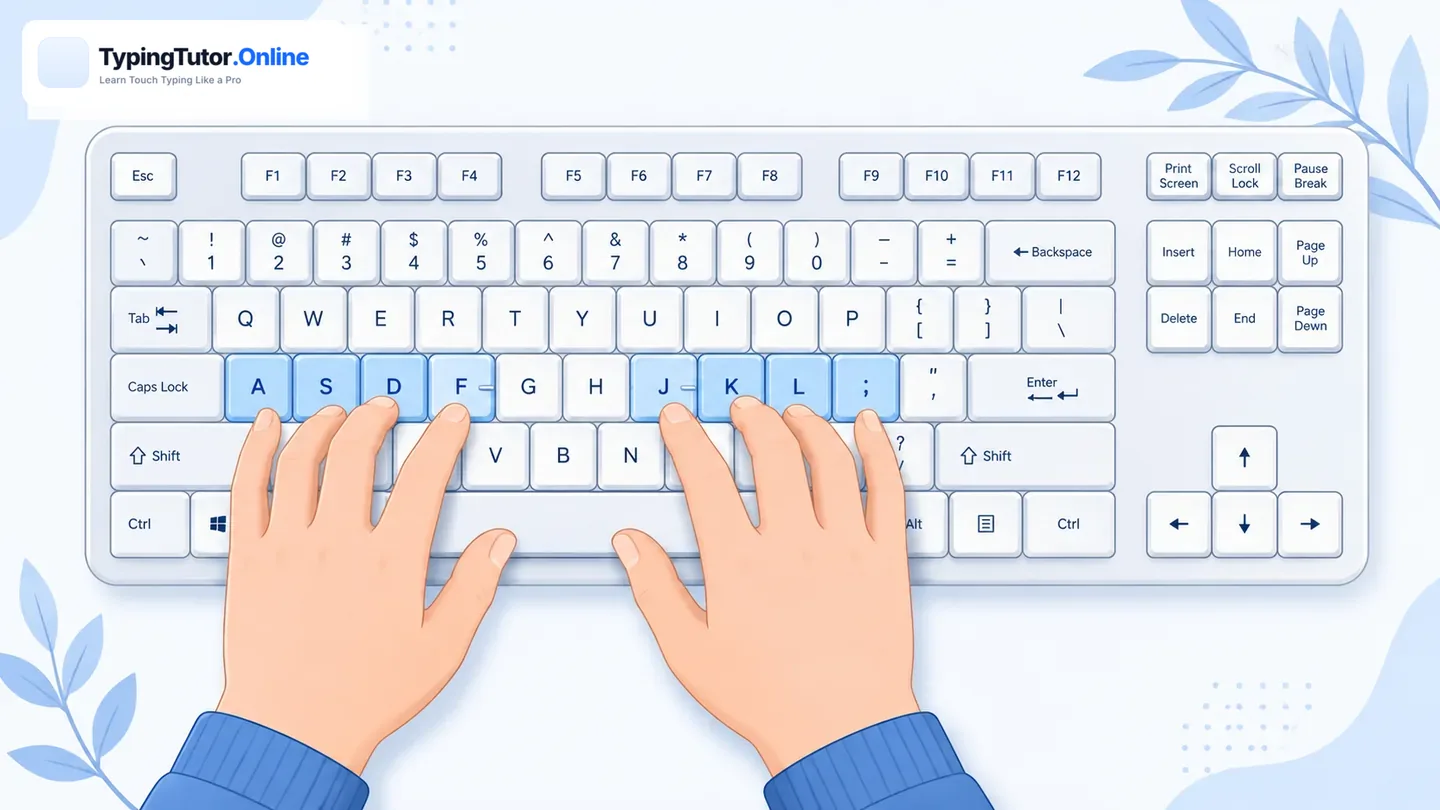
Build the foundation with F and J anchors, then add the remaining home-row letters and punctuation gradually.
1
Lesson 1: F, J and Spacebar
Practice F and J in a steady rhythm and use Spacebar between groups.
2
Lesson 2: New Keys D and K — Review F and J
Practice D–F and J–K pairs until the middle fingers can move independently.
3
Lesson 3: New Keys S and L — Review D F J K
Type S–D and K–L pairs lightly, keeping both wrists still.
4
Lesson 4: New Keys A and Semicolon — Home Row Review
Reach gently to A and semicolon, then rebuild the full ASDF JKL; home position.
5
Lesson 5: New Keys G and H — Complete Home Row
Practice G and H with neighbouring home-row keys, then blend them into full-row patterns.
6
Lesson 6: Home Row Finger Pairs
Build balanced finger pairs and connect G and H smoothly with the complete home row.
7
Lesson 7: Home Row Words
Use G and H naturally inside familiar home-row words and short phrases.
8
Lesson 8: Home Row Rhythm
Maintain a steady rhythm while G and H are blended into full-row patterns, words, and phrases.
9
Lesson 9: Home Row Sentences
Type natural home-row sentences with balanced use of G and H.
10
Lesson 10: Home Row Mastery
Demonstrate complete home-row mastery with balanced G/H drills, words, and sentences.
Lessons 11–20
Top Row
Reach upward with the correct fingers while continuously reviewing the keys already learned.
11
Lesson 11: E and I with Home Row
Every drill combines the new top-row keys with previously mastered home-row keys.
12
Lesson 12: R and U with Earlier Keys
R and U are introduced inside combinations that continually reuse the home row and E/I.
13
Lesson 13: W and O with Cumulative Practice
W and O are blended into home-row reaches, existing top-row keys, words, and sentences.
14
Lesson 14: Q and P with Cumulative Practice
Q and P are practised with all earlier letters rather than as isolated top-row drills.
15
Lesson 15: T and Y with Full Home-and-Top Practice
T and Y complete the top row without separating top-row practice from the home row.
16
Lesson 16: Central Top-Row Keys in Mixed Text
No row is isolated; every stage moves naturally between home and top rows.
17
Lesson 17: Outer Top-Row Keys in Mixed Text
W, Q, O, and P remain connected to the full learned key set.
18
Lesson 18: T and Y in Mixed Text
Each stage mixes T and Y with the entire home-and-top-row set.
19
Lesson 19: Home-and-Top-Row Words
All activities use words and patterns that naturally cross between learned rows.
20
Lesson 20: Complete Home-and-Top-Row Mastery
The final top-row review uses integrated patterns, words, and sentences rather than separate row drills.
Lessons 21–27
Bottom Row
Add the lower keyboard row without losing your home-row position or accuracy.
21
Lesson 21: C and Comma with Earlier Keys
The first bottom-row keys are introduced inside familiar home-and-top-row text.
22
Lesson 22: V and M with Cumulative Practice
V and M are added to the complete learned alphabet set rather than isolated below-row drills.
23
Lesson 23: X and Period with Cumulative Practice
X and period are practised inside cumulative text using every earlier learned key.
24
Lesson 24: Z and Slash with Cumulative Practice
Z and slash are introduced through integrated text rather than an isolated bottom-row block.
25
Lesson 25: B and N with Full Alphabet Practice
B and N complete the letter set and are immediately mixed with all previous rows.
26
Lesson 26: Full-Keyboard Finger Connections
Every drill crosses rows and reinforces the complete alphabet.
27
Lesson 27: Cumulative Full-Keyboard Words
Words are selected for natural row crossing and complete alphabet reinforcement.
Lessons 28–30
Alphabet
Combine the full alphabet into increasingly natural letter patterns and words.
28
Lesson 28: Complete Alphabet Word Flow
All word groups cross rows and reuse the complete learned key set.
29
Lesson 29: Complete Alphabet Sentences
Sentences integrate the full alphabet instead of separating keys by row.
30
Lesson 30: Cumulative Alphabet Mastery
The mastery lesson treats the keyboard as one cumulative set rather than three separate rows.
Lessons 31–35
Capital Letters
Learn opposite-hand Shift technique for capital letters and mixed-case typing.
31
Lesson 31: Left Shift and Capitals
Practice right-hand capital letters one at a time, releasing Shift immediately.
32
Lesson 32: Right Shift and Capitals
Practice left-hand capital letters with a clean press–release Shift rhythm.
33
Lesson 33: Names and Places
Type each name slowly, checking the capital and the following lowercase letters.
34
Lesson 34: Sentence Capitals
Practice sentence starts as one sequence: Shift, capital, release, continue.
35
Lesson 35: Capital Letter Mastery
Mix names and sentence capitals while keeping both hands on their normal positions.
Lessons 36–40
Numbers
Practise the number row for dates, quantities, prices, percentages, and everyday data entry.
36
Lesson 36: Number Keys 1 and 2
Practice 1 and 2 in short groups, familiar words, and complete alphabet review.
37
Lesson 37: Number Keys 3 and 4
Practice 3 and 4 with earlier numbers, familiar words, and cumulative letter review.
38
Lesson 38: Number Keys 5 and 6 with Earlier Numbers
Practice 5 and 6 with earlier numbers, English words, and complete alphabet review.
39
Lesson 39: Number Keys 7 and 8 in Everyday Text
Practice 7 and 8 in number patterns and useful English sentences with earlier keys.
40
Lesson 40: Number Keys 9 and 0 — Number Row Mastery
Practice 9 and 0 with every earlier number, familiar English, and full-keyboard review.
Lessons 41–44
Punctuation
Add common punctuation used in sentences, correspondence, and documents.
41
Lesson 41: Comma and Period Review
Practice punctuation as part of the sentence rhythm: mark, space, next word.
42
Lesson 42: Question Mark and Slash
Alternate slash and question-mark examples, releasing Shift after each question mark.
43
Lesson 43: Colon and Semicolon
Practice short lists and explanations that naturally use both marks.
44
Lesson 44: Apostrophe and Quotation Marks
Practice contractions first, then type short quotations with opening and closing marks.
Lessons 45–50
Symbols
Build confidence with frequently used keyboard symbols and mixed text.
45
Lesson 45: At Sign and Number Sign
Practice email-style and hashtag-style examples with a clean Shift release.
46
Lesson 46: Dollar and Percent Signs
Practice currency and percentage groups slowly, checking symbol placement.
47
Lesson 47: Ampersand and Plus
Practice short labels and simple expressions containing & and +.
48
Lesson 48: Parentheses and Hyphen
Type balanced parenthetical phrases and short hyphenated words.
49
Lesson 49: Symbol Review
Slow down slightly at symbols, then resume the normal text rhythm.
50
Lesson 50: Punctuation and Symbol Mastery
Treat this as a precision review and repeat any symbol pattern that feels uncertain.
Lessons 51–52
Paragraphs
Move from isolated words and sentences to longer continuous typing passages.
51
Lesson 51: Short Paragraphs
Type each sentence as a phrase, pausing only where punctuation naturally requires it.
52
Lesson 52: Long Paragraphs
Use a sustainable pace and recover calmly after any difficult phrase.
Lessons 53–55
Office Typing
Practise realistic workplace text such as messages, emails, and business-style content.
53
Lesson 53: Emails and Messages
Type each message as if it will be sent, checking clarity and formatting while you work.
54
Lesson 54: Reports and Records
Read each record group completely before typing and verify the sequence visually.
55
Lesson 55: Office Typing Mastery
Use a controlled pace and treat every email, date, and report phrase as meaningful data.
Lessons 56–57
Academic Typing
Type structured educational text with careful punctuation and sustained accuracy.
56
Lesson 56: Academic Sentences
Read each clause ahead and keep a measured, accurate pace.
57
Lesson 57: Academic Paragraphs
Type by phrases, using punctuation as a natural point to reset your focus.
Lessons 58–59
Speed and Accuracy
Improve fluency while keeping errors under control and maintaining correct technique.
58
Lesson 58: Accuracy Challenge
Use a slightly slower pace than normal and aim for clean, deliberate keystrokes.
59
Lesson 59: Speed Challenge
Build speed gradually across phrases and slow slightly when accuracy begins to fall.
Lessons 60–60
Course Mastery
Bring the full keyboard together in a final mixed-key mastery lesson.
60
Lesson 60: Final Course Mastery
Type with the sustainable posture, rhythm, and accuracy you want to keep after the course.
How it works
A complete touch typing course, not random practice
TypingTutor.Online teaches one manageable group of keys at a time. Each new lesson mixes the newly introduced keys with keys you already know, so your hands build real keyboard memory instead of memorizing isolated rows. The course begins with F, J and Spacebar, expands through every letter, then adds Shift, numbers, punctuation, symbols, paragraphs, office and academic text, and final speed-and-accuracy work.
Correct finger guidance
Use the onscreen keyboard and hand guides to see which finger should move and where it should return.
Accuracy before speed
A clear lesson target encourages reliable key control before you try to increase words per minute.
Adaptive practice
Lesson pacing can adapt to performance so stronger learners move efficiently while developing learners receive more practice.
Progress you can see
Track completed lessons, current lesson, WPM, accuracy, errors, practice time, and longer-term statistics in your browser.
What you will learn
From home row foundations to complete keyboard mastery
The course is organized into clear skill stages so learners can understand what comes next and why each stage matters.
Home Row10 lessons · Build the foundation with F and J anchors, then add the remaining home-row letters and punctuation gradually.
Top Row10 lessons · Reach upward with the correct fingers while continuously reviewing the keys already learned.
Bottom Row7 lessons · Add the lower keyboard row without losing your home-row position or accuracy.
Alphabet3 lessons · Combine the full alphabet into increasingly natural letter patterns and words.
Capital Letters5 lessons · Learn opposite-hand Shift technique for capital letters and mixed-case typing.
Numbers5 lessons · Practise the number row for dates, quantities, prices, percentages, and everyday data entry.
Punctuation4 lessons · Add common punctuation used in sentences, correspondence, and documents.
Symbols6 lessons · Build confidence with frequently used keyboard symbols and mixed text.
Paragraphs2 lessons · Move from isolated words and sentences to longer continuous typing passages.
Office Typing3 lessons · Practise realistic workplace text such as messages, emails, and business-style content.
Academic Typing2 lessons · Type structured educational text with careful punctuation and sustained accuracy.
Speed and Accuracy2 lessons · Improve fluency while keeping errors under control and maintaining correct technique.
Course Mastery1 lesson · Bring the full keyboard together in a final mixed-key mastery lesson.
More focused paths
Switch to focused typing practice whenever you need it
Your main 60-lesson course stays available while you use focused paths for number entry, kids, programming keys, or mobile typing.
10 Numpad LessonsCalculator-style number entry for digits, decimals, dates and data.Open Numpad lessons →
24 Kids Typing LessonsShort child-friendly lessons with simple goals and practice.Open Kids lessons →
Programmer TypingCode, brackets, symbols and programming-oriented typing practice.Open programmer practice →
Mobile TypingTouch-keyboard lessons, practice, games and a mobile typing test.Open mobile typing →
Printable practice
Typing worksheets for home row, top row, bottom row and alphabet practice
Use print-ready worksheets for slower finger-position practice away from the timer. Each sheet includes a finger guide, key patterns, practice words, writing lines, and a link back to the matching online activity.
Home Row WorksheetASDF JKL; finger placement and writing practice.Open worksheet →
Top Row PracticeQWERTY-row words and controlled reach practice.Open worksheet →
Bottom Row PracticeZXCVBNM movement and finger-position drills.Open worksheet →
Alphabet WorksheetA–Z practice for complete letter recognition.Open worksheet →
All Typing WorksheetsBrowse every printable practice sheet in one place.Browse worksheets →
How to learn touch typing effectively
- Start with Lesson 1. Learn the F and J anchor keys and use a thumb for Spacebar.
- Keep your eyes on the screen. Feel the raised F and J bumps when you need to relocate your hands.
- Use the assigned finger. Avoid reaching with whichever finger feels easiest; correct movement is the skill being trained.
- Meet the accuracy target. Controlled keystrokes are more important than rushing for a high WPM score.
- Practise regularly. A short daily session is easier to maintain and helps key positions become automatic.
How long should you practise?
For a beginner, about 10 to 15 focused minutes a day is a practical starting point. Stop if your hands become tense or your accuracy drops sharply. The goal is to build comfortable, repeatable movement.
As the keyboard becomes more familiar, you can spend longer on words, paragraphs, office text, typing tests, and speed practice. Consistency matters more than one unusually long session.
Read the beginner typing-practice guide →Who it helps
Typing lessons for beginners, students and everyday computer users
Learn the keyboard systematically instead of trying to type fast before key positions are familiar.
Build confidence for assignments, research, online learning, exams, and longer written work.
Practise the letters, numbers, punctuation, symbols, and realistic text used in everyday computer work.
Use accuracy targets, statistics, weak-key feedback, and later lessons to improve consistency and speed.
Learn at your own pace
Touch Typing Course for Beginners and Adults
This free online touch typing course works for first-time learners as well as adults who already type but want better technique. Start with home-row finger placement, use the on-screen keyboard and hand guidance when a key feels unfamiliar, and progress into full-keyboard words, sentences, paragraphs, numbers, punctuation, speed, and accuracy practice.
If you already know the keyboard, you can rebuild weak finger habits and then measure improvement with touch typing speed tests, reinforce difficult keys through touch typing games, or use Typing Practice for Adults for stories, business, marketing, workplace writing, and personal-growth passages.
Questions learners ask
Typing lessons FAQ
Are the typing lessons free?
Yes. The complete 60-lesson TypingTutor.Online course can be used without paying or creating an account.
Which typing lesson should a beginner start with?
A new learner should begin with Lesson 1. It introduces the F and J home keys and the Spacebar before new keys are added gradually.
How many typing lessons are in the course?
The course contains 60 guided lessons, moving from home-row foundations through the full alphabet, capitals, numbers, punctuation, symbols, paragraphs, office and academic typing, speed, accuracy, and final mastery.
How long should I practise typing each day?
For most beginners, a focused daily session of about 10 to 15 minutes is a practical starting point. Regular short practice is usually easier to sustain than occasional long sessions.
Should I look at the keyboard while learning touch typing?
Try to keep your eyes on the lesson text. Use the raised bumps on F and J to relocate the home row and let the onscreen keyboard and hand guidance show which finger should move.
When should I move to the next lesson?
Move forward when you can meet the lesson accuracy target with relaxed, controlled finger movement. Speed should increase after the key positions feel reliable.
Does TypingTutor.Online save my progress?
Yes. Lesson progress and results are stored locally in the browser you are using. An account is not required.
Can I use the course on a laptop keyboard?
Yes. The lessons are designed around a standard keyboard layout and work well for desktop and laptop typing practice.
Is this course useful for office and school typing?
Yes. Later lessons include paragraphs, office-style text, academic typing, numbers, punctuation, symbols, speed, and accuracy practice.
Check Your Progress
Take a typing test to measure your improvement, then use the Typing Speed Improver when you want targeted training.
For adults who want to learn touch typing, the same structured course can be started from the first unfamiliar key group. Adults, students, and complete beginners can keep sessions short and use tests later to measure practical improvement.
Test and play each keyboard row
After the home-row lessons, measure the same keys with the Home Row Typing Test or reinforce them in the Home Row Typing Game. Continue the same pattern with the Top Row Typing Test, Top Row Typing Game, Bottom Row Typing Test, and Bottom Row Typing Game. When you want targeted speed work, use the Typing Speed Improver to identify weak keys and slow transitions.
Student typing practice: Lessons 1, 2 and 4
If you are looking for a student typing test for a numbered lesson, start with the course activity for that lesson. These lessons build keyboard familiarity through focused key practice; timed paragraph tests measure a different skill. Lesson numbers below refer to the TypingTutor.Online course.
- Lesson 1: F, J and Spacebar introduces the anchor keys and relaxed thumb use.
- Lesson 2: D and K adds new keys while reviewing F and J.
- Lesson 4: A and semicolon continues home-row practice using previously learned keys.
Follow the course order and repeat unfamiliar keys before moving on. When you are ready for connected text, try a 1-minute student typing test, then a 3-minute or 5-minute typing test. Students completing a teacher assignment should start it from their student dashboard.