

How to Practise Weak Keys and Fix Typing Errors
Weak keys are the letters, numbers, or symbols that cause more hesitation or errors than the rest of your keyboard. The fastest way to improve them is not to repeat one key endlessly, but to practise it in short focused combinations and then return it to normal words and sentences.
You do not have to guess which keys are holding you back. As you work through the guided typing tutor, TypingTutor.Online records key-level practice performance in your browser and can identify the keys that repeatedly cause mistakes or slow reactions. Your weak-key results can then be turned into focused review through the Weak-Key Coach and the Weak-Key Challenge. If you are still learning touch typing, start with our tutor so your practice data can gradually become personalised.
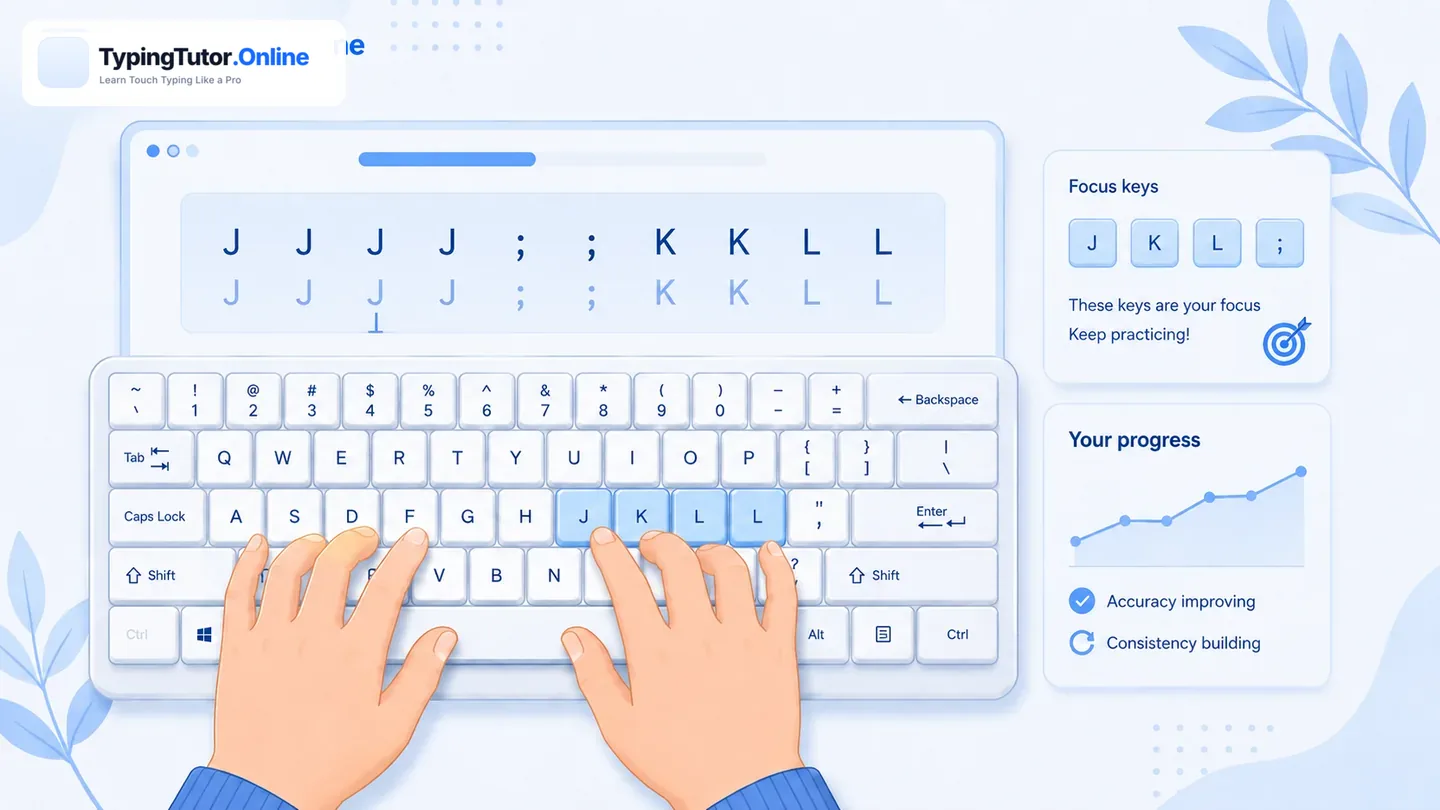
How TypingTutor.Online detects your weak keys
During guided lessons, the tutor tracks each practised key locally in your browser. After enough attempts, it can compare key accuracy, repeated errors, and response speed to show which keys need attention, which are improving, and which have become strong. This gives you a practical weak-key list based on your own typing rather than a generic drill.
Once weak keys are identified, use the Weak-Key Coach for personalised review or open the Weak-Key Challenge for a more playful practice session. New learners should continue the guided typing course as well, because strong finger placement and whole-keyboard rhythm make weak-key practice much more effective.
Start with evidence, not guesses
Review the weak-key information collected from your guided lesson practice instead of choosing difficult keys at random. Focus first on keys that repeatedly show lower accuracy or slower reactions, then return them to normal words and sentences so the improvement carries into real typing.
Slow down before you speed up
If a key is unreliable, reduce speed until the correct finger movement feels repeatable. Clean keystrokes matter more than forcing a high WPM while the same mistake keeps returning.
Practise a weak key until it can be typed accurately in combinations, words, and sentences. A key is not truly improved just because you can hit it correctly in isolation.
Use three layers of practice
- Key pairs: combine the weak key with nearby familiar keys.
- Short patterns: alternate hands and change the surrounding letters.
- Real text: use words and sentences that contain the weak key naturally.
Keep weak-key sessions short
Three to five focused minutes is usually enough for one weak-key block. If accuracy starts falling because of tension or fatigue, return to normal practice and revisit the key later.
Do not neglect strong keys
A balanced practice session should still include normal course work. This keeps rhythm and whole-keyboard coordination growing while the difficult keys receive extra attention.
A simple 10-minute weak-key routine
- Two minutes of normal warm-up.
- Three minutes focused on the weakest two to four keys.
- Three minutes of words or sentences containing those keys.
- Two minutes of normal typing to confirm the improvement transfers back to real text.
Practise the movement, not only the character
A weak key is often a movement problem rather than a memory problem. Notice which finger is responsible for the key, where that finger starts, and whether it returns to its home position afterward. If your hand drifts across the keyboard, the next key can become harder even when the first one was correct.
Mix difficult keys with strong neighbours
Once a weak key feels comfortable by itself, combine it with keys you already type well. For example, if R is weak, practise short combinations such as fr, dr, re, and tr, then move into real words. This keeps the drill connected to normal typing rather than teaching an artificial rhythm that disappears in sentences.
Watch for repeated error patterns
Two learners can have the same weak key for different reasons. One may press the wrong neighbouring key, another may hesitate, and another may use the wrong finger. The best practice depends on the pattern: accuracy errors need slower control, hesitation needs repetition, and wrong-finger habits need deliberate finger guidance.
When should you test again?
Do not retest after every short drill. Complete a focused practice block, return to normal text, and then use a short test later in the session or on the next day. Improvement that survives outside the drill is more meaningful than a temporary perfect score on one repeated pattern.
Weak-key practice questions
Should I practise only my weakest key?
No. Short focused practice is useful, but mix the weak key with neighbouring keys and normal text so the movement becomes part of real typing.
How do I know a weak key is improving?
Look for fewer errors, less hesitation, and better accuracy across several sessions rather than one perfect drill.