

Left Hand Typing Practice: Improve Control, Accuracy and Weak Fingers
If your left hand feels slower or less coordinated than your right, focused practice can help—but the goal is still balanced two-hand typing, not teaching one hand to replace the other.
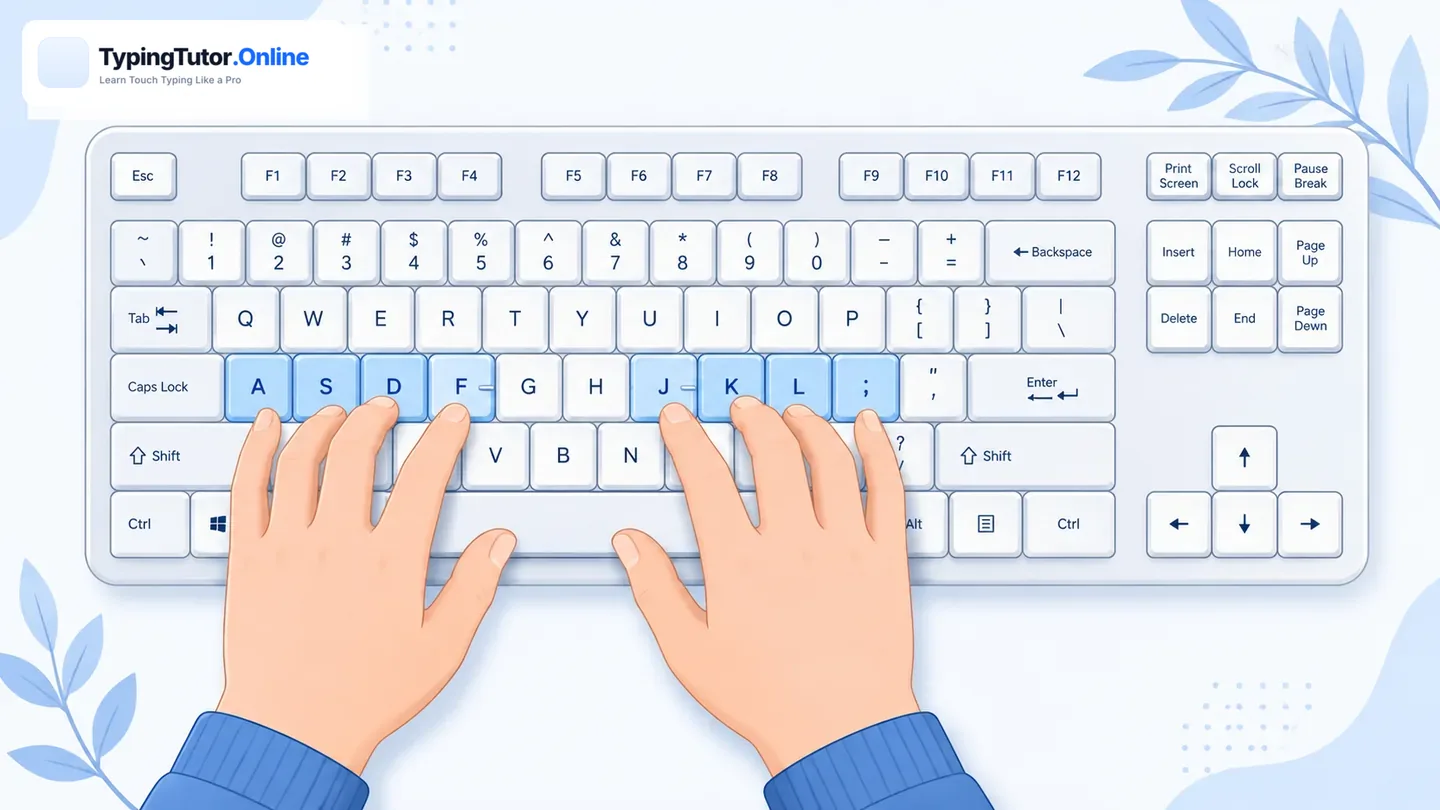
Which keys belong to the left hand?
On a standard QWERTY layout, the left hand covers most of Q W E R T, A S D F G, and Z X C V B. The index finger handles the largest area, including F, G, R, T, V and B. The little finger also operates left Shift when the right hand types a capital.
Start with the home position
Rest the left little, ring, middle and index fingers on A, S, D and F. Use the raised mark on F to relocate the hand without looking down. Practise short reaches and return each finger to its home key.
Left hand typing practice for weak fingers
Ring and little fingers often feel less independent. Practise S/W/X and A/Q/Z slowly, keeping the wrist still. Do not let the index finger take over simply because it feels stronger.
Open the finger guide Start guided lessons
Keep two-hand typing as the final goal
Focused left-hand drills are useful when correcting an imbalance, but normal touch typing should distribute work between both hands. After a short left-hand drill, return to words and sentences that alternate between both hands.
Use statistics to find the real problem
If only one or two left-hand keys cause mistakes, practise those keys instead of treating the entire hand as weak. Weak-key statistics can make practice more specific and efficient.
Left hand reaches to practise
Practise F-to-R, F-to-T, D-to-E, S-to-W and A-to-Q as small upward movements. On the bottom row, practise F-to-V/B, D-to-C, S-to-X and A-to-Z. Return to A-S-D-F after each reach rather than leaving the hand displaced.
Left Shift practice
The left little finger normally holds left Shift while the right hand types a capital. Practise simple right-hand capitals and release Shift immediately after the letter. This prevents Caps Lock from becoming a substitute for normal single-capital technique.
Balance the left hand with normal text
After a focused drill, type sentences containing both left- and right-hand words. This checks whether the left-hand improvement works in the real two-hand rhythm used for everyday typing.