Word and Sentence Typing Practice: Move from Keys to Fluent Text
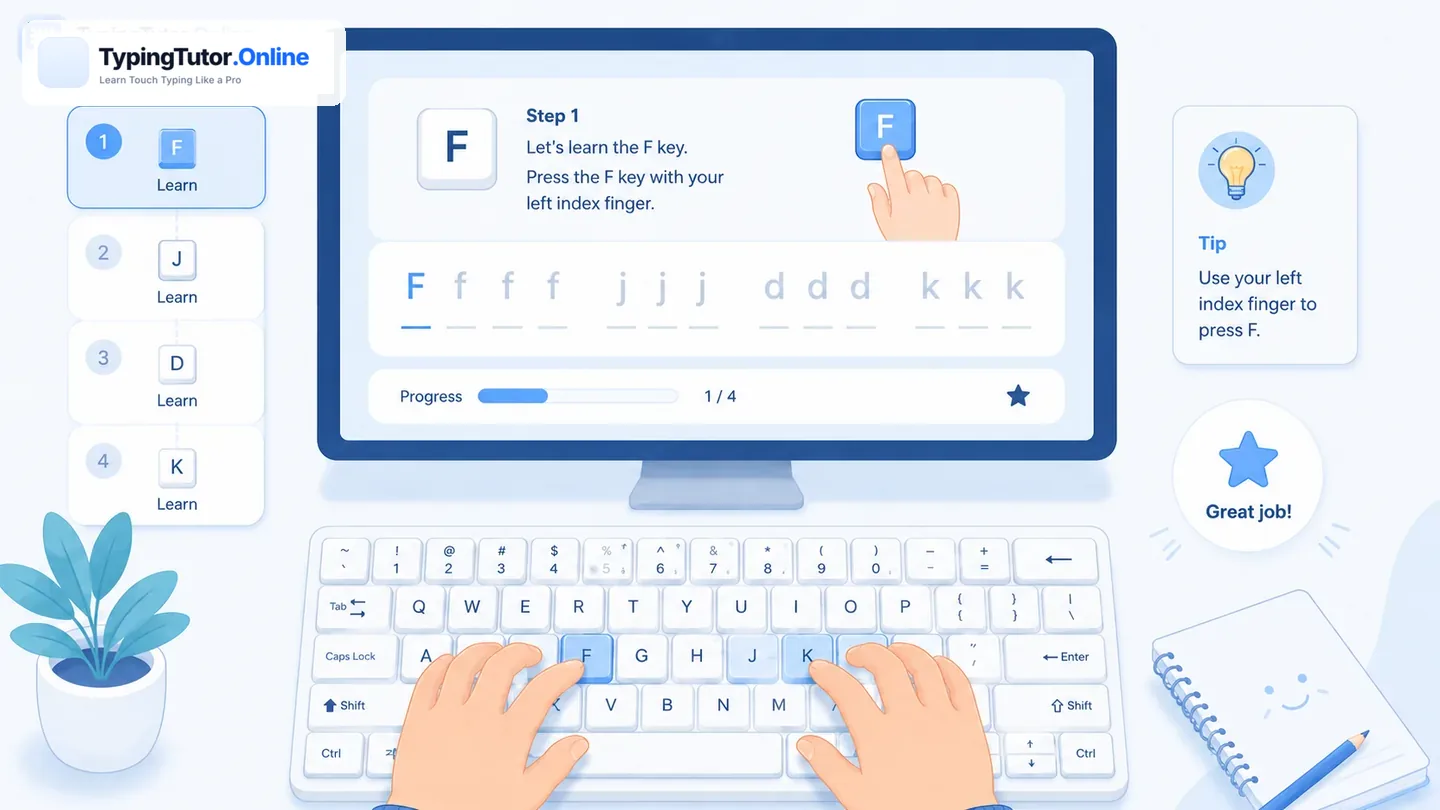
Typing individual keys is necessary at the beginning, but fluency develops when those movements are connected into familiar words and complete sentences.
Why word typing practice matters
Words teach your fingers to recognise common movement patterns. Instead of thinking about each letter independently, you begin to type familiar sequences as smoother units.
Typing sentences practice adds real structure
Sentences introduce spaces, capitals and punctuation while requiring you to maintain rhythm across multiple words. This is an important bridge between lessons and paragraph practice.
A useful progression
- Learn the correct finger for each new key.
- Practise short key combinations.
- Type real words using the learned key set.
- Move to short phrases and sentences.
- Use paragraphs and timed tests for endurance.
Start cumulative typing lessons Practise continuous text
Do not wait too long to use meaningful language
Once the learned keys can form real words, use them. Meaningful text is easier to recognise and closer to the skill you ultimately want: typing useful language rather than memorising random patterns forever.
Repeat weak transitions, not entire pages
If one word causes repeated errors, identify the difficult transition and practise it briefly. Focused correction is usually more efficient than restarting a long paragraph every time one sequence goes wrong.
How long should word practice last?
Use it until familiar words can be typed without stopping between letters. Then move quickly into sentences. Staying on isolated words for too long can limit practice with spacing, capitals and punctuation.
Sentence practice for accuracy
Type at a pace that lets you notice upcoming punctuation and word boundaries. If you constantly backspace, reduce speed. The purpose is to build an accurate movement sequence that can later be performed faster.
Use natural phrases
Realistic phrases are easier to transfer to normal typing than random strings. A cumulative tutor can introduce meaningful words as soon as the available letters permit them, then gradually extend those words into sentences and paragraphs.