Touch Typing Online UK: A Practical Guide for Learners
If you are searching for touch typing online in the UK, the core skill is the same as anywhere else: learn reliable finger-to-key movements so you can type while keeping your attention mainly on the screen. The useful UK-specific questions are usually about keyboard layout, school or workplace use, and whether an online course can be practised easily at home without special software.
Can you learn touch typing online in the UK?
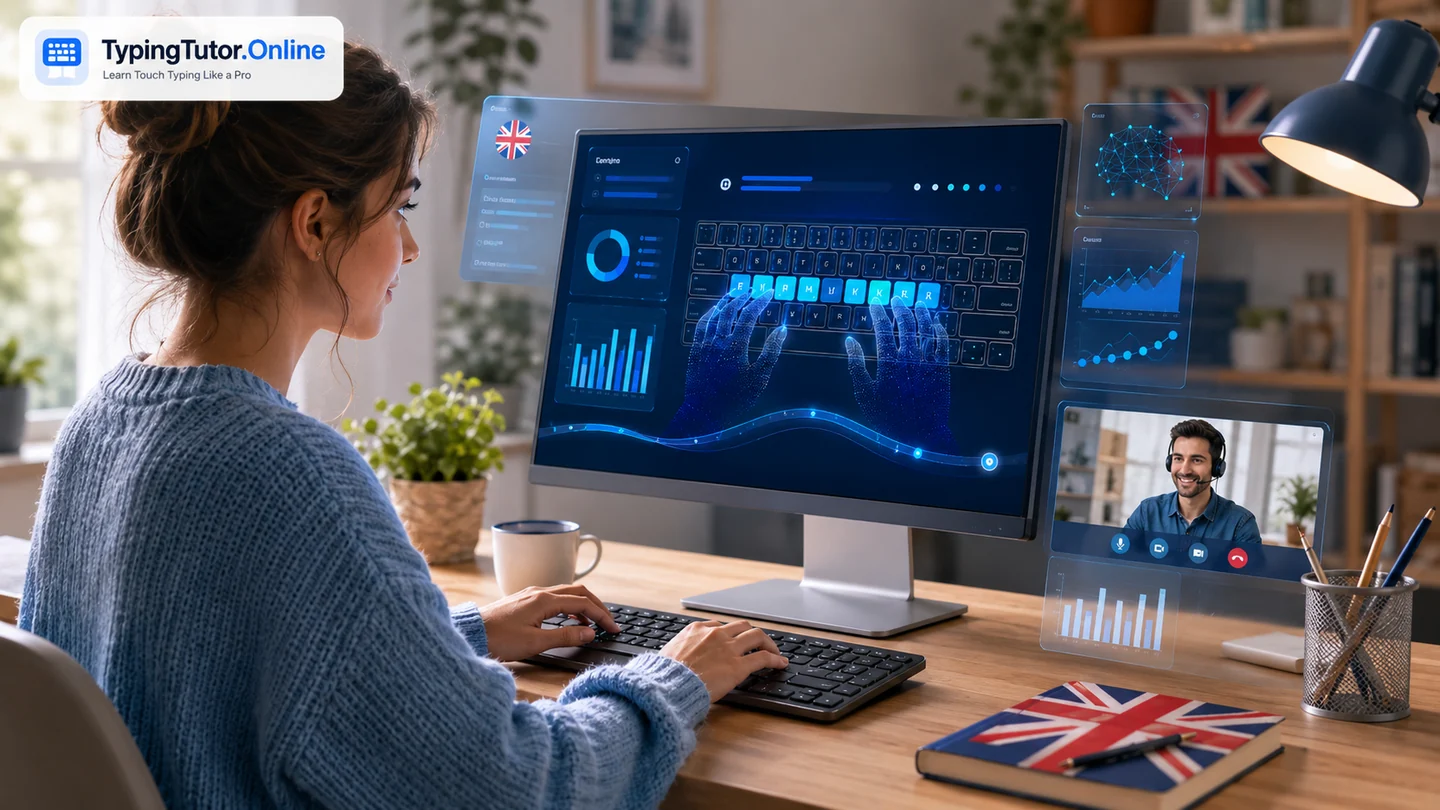
Yes. A browser-based typing course can be used from home, school, college, or work wherever a standard keyboard and modern browser are available. The learning sequence—home row, other letter rows, Shift, punctuation, numbers, and symbols—does not depend on being in a classroom.
TypingTutor.Online is a web-based learning service, so UK learners can begin with the course, practise in the browser, and use typing tests to measure progress.
UK keyboard layout: what should learners know?
Most UK desktop keyboards use a UK QWERTY layout. The alphabet keys are in the familiar QWERTY positions, so the basic letter-finger technique is the same. Some punctuation and symbol positions differ from US keyboards—for example, the placement of certain quotation, pound, at-sign, and backslash-related keys can vary.
When you move beyond letters, practise on the physical layout you actually use. This is especially important if your school, office, examination centre, or laptop has a UK keyboard.
Who can benefit from learning?
Touch typing can support pupils writing school work, students producing essays and research, learners doing office administration, and anyone who spends substantial time in email, documents, spreadsheets, coding tools, or online communication. The value comes from smoother keyboard control, not from achieving an arbitrary headline speed.
Should children and learners use the same course?
The finger mechanics are similar, but the presentation should match the learner. Learners often prefer task-focused practice and clear performance statistics. Younger learners benefit from shorter sessions, simpler text, encouragement, and games. TypingTutor.Online therefore has a dedicated Kids section alongside the main learning path.
How much practice is enough?
For a beginner, a short daily routine is usually easier to sustain than occasional long sessions. Start with accuracy and relaxed hands. Add speed only when the current keys feel predictable. If you are preparing for a school, recruitment, or workplace typing requirement, use a test length that resembles the task you will actually face.
What should a UK learner look for in an online tutor?
- Clear home-row and finger-position teaching.
- Practice that progresses from keys to real sentences and paragraphs.
- Support for punctuation and symbols on the keyboard you use.
- WPM and accuracy measurement.
- Short lessons that can be repeated without an account barrier.
- Practice options for everyone as well as a suitable Kids experience.
What about certificates?
A certificate can be useful as a record of a completed milestone, but it should not be treated as a regulated UK qualification unless it genuinely is one. TypingTutor.Online certificates document results and course achievements inside the platform; they do not claim to replace employer, school, awarding-body, or government assessment requirements.
If you want to measure yourself, start with a normal short typing test and later use the certificate test when you want a longer verified result.
Learn the universal letter technique first, then deliberately practise the punctuation and symbols on your own UK keyboard so the physical layout becomes familiar as well.
Quick questions
Is TypingTutor.Online only for UK users?
No. It is an online typing platform available to learners in many countries. This guide simply addresses common UK-specific keyboard and learning questions.
Is a UK keyboard very different for touch typing?
The main letter layout is still QWERTY, so the core finger method is the same. Some symbols and punctuation positions differ and should be practised on your actual keyboard.
Can schools use online typing practice?
Learners can use browser-based lessons and practice, subject to the school or organisation’s own policies and device settings.