

Typing Speed Test for Everyone: What WPM Should You Aim For?
There is no universal typing-speed requirement. For many learners, 40–50 WPM with good accuracy is a useful practical goal, while 60 WPM is already a strong general speed. Your best target depends on your work, study and daily computer use.
Start with a real typing speed test
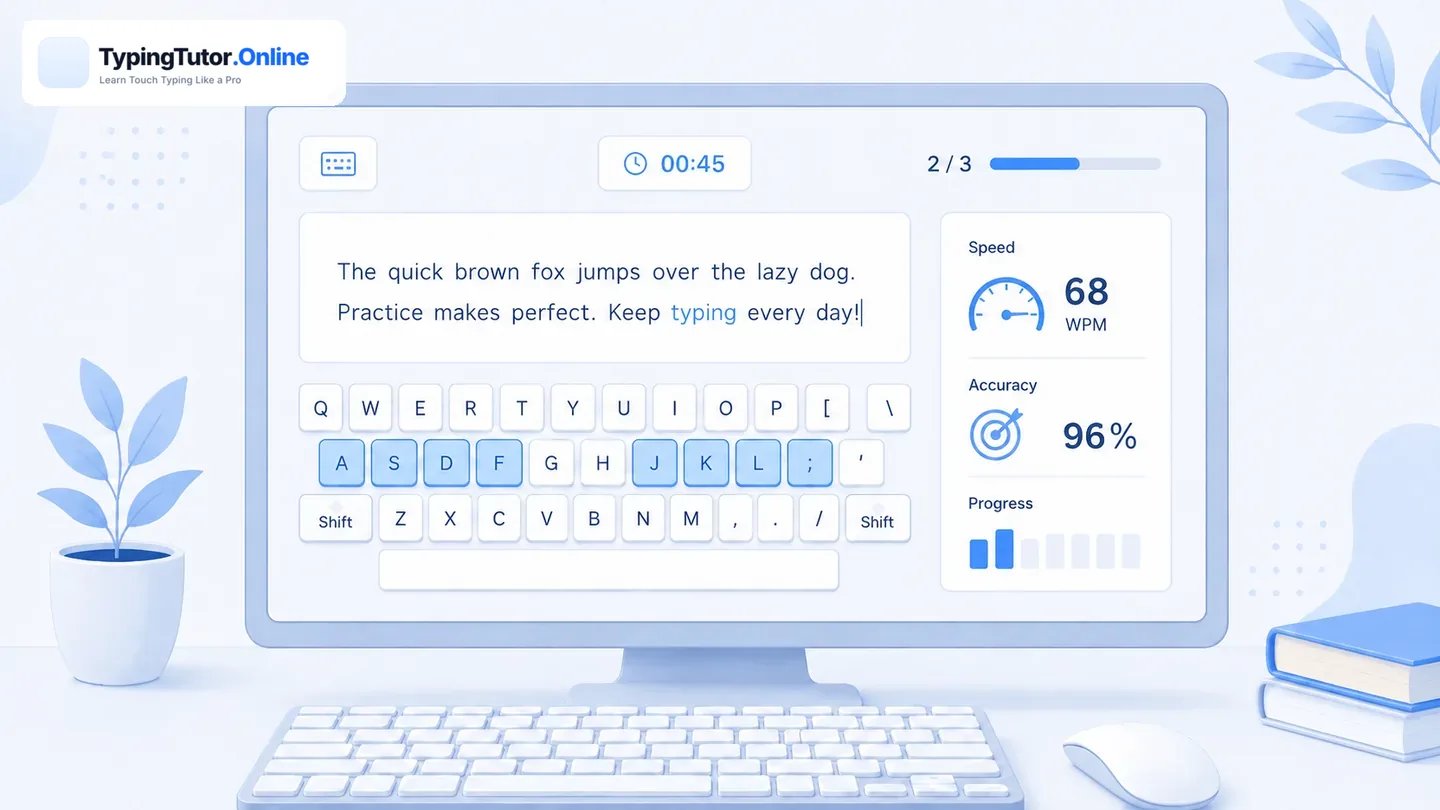
An typing-speed test should measure more than a short burst. Use a 1-minute test for a quick check, then confirm your level with the 5-minute typing test. The longer result is usually more useful because it shows whether you can hold speed and accuracy after the first minute.
Take the 5-minute test Type & Learn practice
What WPM should a learner aim for?
There is no single correct number for every learner. Your useful target depends on what you do on a computer. A large Aalto/Cambridge study found most volunteer typists between 30 and 60 WPM, with an average near 52 WPM. Separately, the U.S. Office of Personnel Management uses 40 WPM as the proficiency requirement for certain federal typing and office-automation roles. Together, those references make 40–50 WPM a sensible practical target for many learners, while 60 WPM is already a strong general result.
| Everyday use | Useful practice goal | What matters most |
|---|---|---|
| Everyday computer use | 30–40 WPM | Comfort, correct keys and low error rate. |
| Study / teaching / general writing | 35–50 WPM | Steady paragraphs, punctuation and accuracy. |
| Office / admin | 40–50 WPM | Email, forms, documents and reliable sustained typing. |
| Chat support / virtual assistance | 40–50 WPM | Quick responses with high accuracy; employer rules vary. |
| Programming / IT | 45–60 WPM | Fast key control helps, but symbols, code accuracy and problem-solving matter more than raw WPM. |
| Data entry / accounting | 40–50 WPM + numpad | Very high accuracy and numeric-keypad skill can matter as much as text speed. |
These are practice goals, not hiring rules. If an employer or exam publishes a minimum, follow the exact requirement. Our Required Typing Speed guide covers official exam standards and job examples.
How to read your result
- Below 30 WPM: do not worry about speed yet. Learn the keyboard and reduce searching for keys.
- 30–40 WPM: useful everyday typing; keep building accuracy and rhythm.
- 40–50 WPM: strong for many study and office tasks.
- 50–60 WPM: fast for most ordinary computer work.
- 60+ WPM: very good general speed if the text remains accurate.
Accuracy first, then speed
If your WPM rises while your accuracy falls, you are not really becoming more efficient. For normal learning, aim for at least 95% accuracy and preferably higher. If errors cluster around the same letters, use the Weak-Key Challenge or return to the lesson where those keys were introduced.
Copy typing and real writing are different
Most speed tests measure copy typing: you reproduce text that is already on screen. Real work often includes thinking, choosing words and editing. If you want to measure that skill, use the Blank Page for Typing, which reports Writing WPM while you compose your own notes, email, letter or ideas.
A simple improvement path
- Learn the key positions. Use the 60-lesson touch typing course if you still look for keys.
- Practise meaningful text. Use Type & Learn for stories, business, marketing and workplace writing.
- Fix weak keys. Accuracy improvement usually gives speed a better foundation.
- Measure weekly. Compare the same 5-minute test format instead of taking many random tests every day.
- Match the goal to your life. A programmer, accountant, teacher and chat agent do not need exactly the same keyboard skills.
Sources checked
- Aalto University — large-scale typing study summary
- Aalto University research portal — peer-reviewed CHI 2018 study
- U.S. Office of Personnel Management — 40 WPM typing proficiency reference
Frequently asked questions
What is a good typing speed for everyone?
There is no universal requirement. Around 40–50 WPM with good accuracy is a useful practical target for many everyday office, study and communication tasks.
What is the average typing speed for everyone?
A large volunteer study of 168,000 typists reported an average near 52 WPM and found most participants between 30 and 60 WPM, but the sample was not a perfect cross-section of all learners.
Should learners use a one-minute or five-minute typing test?
Use one minute for a quick check. Use three to five minutes when you want a steadier measure of sustained speed and accuracy.
How can I improve typing speed?
Learn correct finger placement, keep accuracy high, practise weak keys, then use words, paragraphs and longer tests. Repeating speed tests alone usually does not fix technique.