Pre-Employment Typing Test: Free Practice and Preparation
A pre-employment typing test is used before hiring or job placement to check whether an applicant can type accurately and fast enough for the role. This guide explains what employers may measure, how to practise, and how to avoid common mistakes before test day.
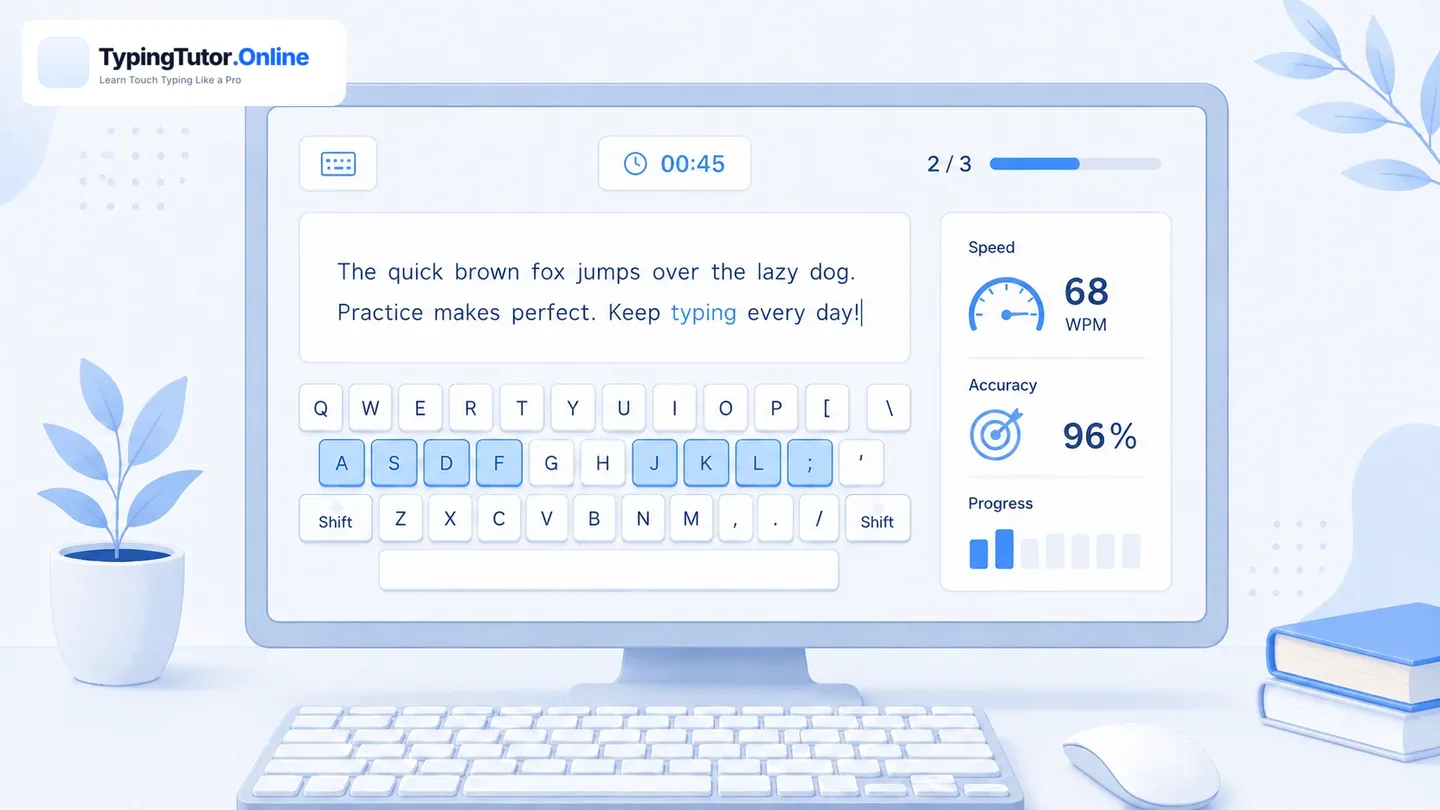
Quick answer: a pre-employment typing test usually measures WPM and accuracy under timed conditions. Practise with unfamiliar text, match the employer's stated test length when possible, and prioritise repeatable accuracy over one unusually fast score.
What is a pre-employment typing test?
A pre-employment typing test is an assessment taken before a person is hired, placed by a staffing agency, or moved forward in a recruitment process. It is common in jobs where typing is part of daily work, such as administrative support, customer service, clerical work, data entry, reception, scheduling, and some remote roles.
The test may be completed online at home, in an office, through a recruitment platform, or under supervision. The employer decides which score matters and whether errors are penalised.
What does the test measure?
The most common measures are:
- Gross WPM: how much text you type before error adjustment.
- Net WPM / NPWM: speed after the effect of errors is considered.
- Accuracy: the percentage of typed characters or words that match the source.
- Errors: mistakes, omissions, substitutions, or extra characters.
- Consistency: whether your speed remains reasonably stable during the test.
Read How Typing Tests Calculate WPM, Accuracy and Consistency if you want to understand the scoring before you practise.
How long is a pre-employment typing test?
There is no universal length. Short tests can be useful for screening, while longer tests show whether an applicant can maintain speed and accuracy. If the employer tells you the duration, practise that duration directly.
When the length is unknown, a 5-minute typing test is a useful general preparation format because it is long enough to reveal pacing, fatigue, and error patterns without becoming an endurance exercise.
What WPM is good for a pre-employment test?
The job advertisement or recruiter is the best source. Different roles can have very different requirements.
If no target is given, a practical general-office preparation goal is around 40–50 WPM with strong accuracy, but that is not an official rule. Some roles may require less, while data-heavy or transcription-focused roles may expect more.
Our Required Typing Speed for Jobs and Exams explains why one WPM number cannot represent every job.
Free pre-employment typing test practice
You can practise without creating an account:
- Take the 5-Minute Typing Test.
- Record your WPM, Net WPM, accuracy, and errors.
- Identify the keys or patterns causing repeated mistakes.
- Use focused typing practice or the structured typing lessons.
- Retest with a different passage.
- Repeat until your normal result—not just your best result—is close to your target.
How to prepare the day before the assessment
Avoid trying to double your typing speed overnight. Last-minute over-practice can make your hands tense and your accuracy worse.
Instead:
- Do one or two short warm-ups.
- Practise the same test duration you expect to face.
- Use your normal keyboard if the real test will be remote.
- Check that your browser and keyboard work correctly.
- Rest if your hands become uncomfortable.
- Read the recruitment instructions again so you know whether corrections or Backspace are allowed.
Common mistakes in job screening tests
Chasing WPM and ignoring accuracy
A high gross speed can look impressive while a lower net score exposes too many errors. Build a pace you can control.
Practising the same paragraph repeatedly
Memorising a passage creates an unrealistic result. Rotate texts so your eyes and fingers must process unfamiliar material.
Looking at the keyboard too often
Frequent glances interrupt reading and rhythm. If this is a problem, use our typing without looking practice.
Using a phone for a desktop job test
If the employer expects physical-keyboard typing, practise on a physical keyboard. Mobile typing is a different skill and should not be compared directly with desktop WPM.
Can you retake a pre-employment typing test?
That depends entirely on the employer or platform. Some recruiters allow another attempt; others treat the first completed score as final. Do not assume you can restart. Before beginning, close distractions and make sure your keyboard is functioning.
On TypingTutor.Online you can practise as often as needed, but those practice attempts do not change the rules of an employer's official assessment.
Can a certificate help with a job application?
A verifiable typing certificate can document a result achieved on TypingTutor.Online. It may be useful as supporting evidence on a resume, portfolio, or application when appropriate, but an employer can still require its own test.
Use the Typing Certificate Test when you are ready for a longer, evidence-based attempt.
Related employment typing resources
- Employment Typing Test Online
- Job Typing Test Online
- Employee Typing Test
- Employment Agency Typing Test
- Typing Test Tips
Frequently asked questions
What is a pre-employment typing test?
It is a typing assessment taken before hiring or job placement to measure keyboard speed, accuracy, and sometimes consistency or errors.
How long is a pre-employment typing test?
There is no universal duration. If the employer gives a test length, practise that length. When the duration is unknown, a 5-minute test is a useful general preparation format.
What WPM should I aim for?
Use the employer target when one is provided. Without a stated target, around 40–50 WPM with strong accuracy is a useful general-office preparation goal rather than an official rule.
Can I practise a pre-employment typing test for free?
Yes. TypingTutor.Online provides free timed typing tests that can be repeated with different text for practice.
Can I retake an employer typing test?
That depends on the employer or assessment platform. Do not assume a retake is allowed; follow the instructions supplied with the official assessment.